

Sanitary Material Handling and Hygienic Equipment
Why Choose Material Handling Products for Global Sourcing?
Global sourcing can make material handling products more accessible, competitive, and adaptable to different operational needs. Warehouses, factories, ports, and distribution centers often require equipment that performs reliably under daily pressure. Conveyors, pallet trucks, shelving systems, lifting equipment, and storage accessories must match real working conditions. A product that looks suitable in a catalog may fail when exposed to heavy loads, narrow aisles, dust, or frequent movement.
Experienced buyers examine more than unit price. They review load capacity, materials, safety features, maintenance requirements, certifications, and replacement-part availability. Supplier audits, sample inspections, factory communication, and documented quality checks can reduce avoidable risks. Clear specifications also help prevent misunderstandings across languages, time zones, and technical standards. Reliable suppliers should explain production capabilities honestly and provide consistent records.
No sourcing plan is flawless. Unexpected delays happen. A cheaper quotation may hide weak packaging, unclear warranties, or expensive after-sales service. These limitations deserve attention before a purchase decision is made. Global sourcing also requires careful review of applicable import rules, product standards, labeling requirements, and workplace safety expectations in the destination market. Independent testing or professional advice may be appropriate for higher-risk equipment.
The strongest approach balances cost, performance, compliance, and long-term support. With practical evaluation and transparent supplier relationships, businesses can choose material handling products that support safer workflows and measurable efficiency. The goal is not simply to buy internationally. It is to source with evidence, patience, and room for improvement.
What Are Material Handling Products in Global Sourcing?
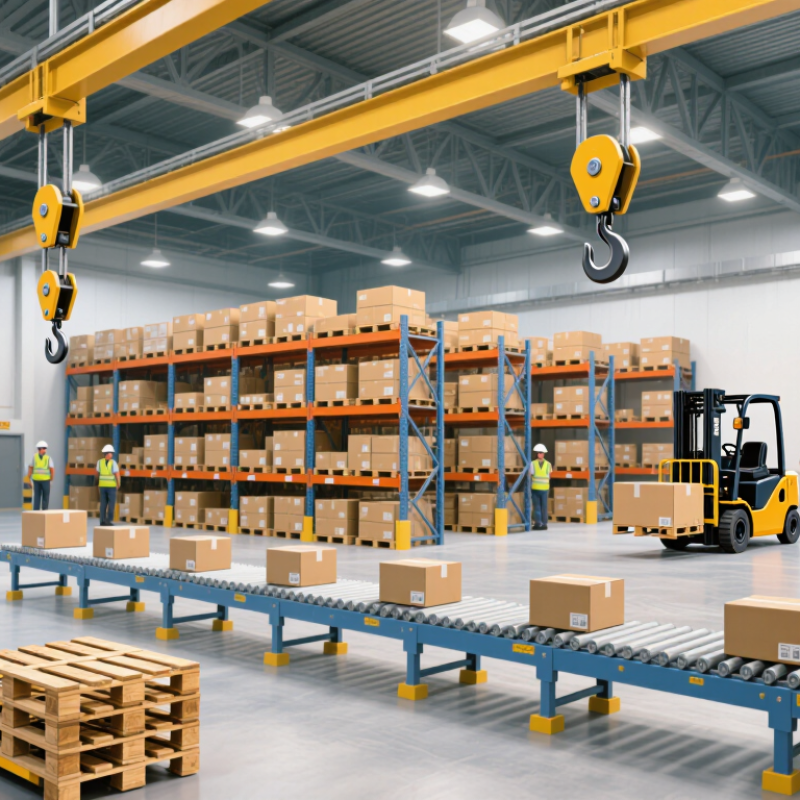
Material handling products are the physical tools that move, store, protect, and control goods across global supply chains. They include conveyors, pallet trucks, shelving, racks, containers, lifting equipment, sortation systems, and warehouse software. In global sourcing, these products connect factories, ports, distribution centers, and final delivery points. They reduce unnecessary handling and make product flow more visible.
The MHI 2024 Annual Industry Report found that 55% of supply chain professionals expected to adopt robotics and automation within five years. This trend increases demand for scalable handling equipment. Buyers must assess load capacity, aisle width, floor conditions, safety features, maintenance access, and local technical support. A low purchase price may hide expensive installation or spare-parts delays. The category is not perfectly tidy. One conveyor design may work well in a dry warehouse but fail in a humid facility. Country-specific electrical standards also require careful verification.
Tips: Request tested specifications, installation drawings, and service records. Compare total ownership cost, not only the quoted price. Ask suppliers to explain performance under real working conditions. ASTM and ISO guidance can support safer selection, while the World Robotics 2023 report recorded 553,052 industrial robot installations worldwide in 2022, showing how automation is reshaping material movement. I still recommend a small pilot. Product data can look convincing, but operators often reveal problems that spreadsheets miss.
Why Choose Material Handling Products for Global Sourcing? - What Are Material Handling Products in Global Sourcing?
A practical comparison of commonly sourced material handling products, their uses, typical specifications, and key purchasing considerations.
| Product Category | Primary Function | Common Materials | Typical Capacity or Size | Global Sourcing Value | Key Verification Points |
|---|---|---|---|---|---|
| Pallets | Support and stabilize goods during storage and transportation. | Wood, plastic, steel, or composite materials. | Common footprints include approximately 1,200 × 1,000 mm and 1,200 × 800 mm; capacity depends on design and load distribution. | Standardized dimensions can improve compatibility with warehouse racks, forklifts, and shipping systems. | Material strength, static and dynamic load ratings, moisture resistance, repairability, and applicable export requirements. |
| Hand Pallet Trucks | Move palletized loads over short distances without powered lifting equipment. | Steel frame, hydraulic components, polyurethane or nylon wheels. | Many standard models are rated from about 900 to 2,500 kg, depending on configuration. | Simple mechanical design, low energy requirements, and broad compatibility with standard pallets. | Rated capacity, fork dimensions, turning radius, hydraulic leakage control, wheel durability, and maintenance support. |
| Platform Carts | Transport boxes, tools, components, and irregular loads within facilities. | Powder-coated steel, stainless steel, aluminum, and molded plastic. | Common load ratings range from approximately 225 to 900 kg, with larger industrial models available. | Flat-pack or modular designs can reduce shipping volume and support different facility layouts. | Frame weld quality, caster type, brake performance, deck size, corrosion resistance, and ergonomic handle height. |
| Warehouse Shelving | Store cartons, components, spare parts, and manually handled inventory. | Cold-rolled steel, galvanized steel, wire decking, and laminated panels. | Typical shelf capacities range from approximately 90 to 1,100 kg per level, subject to design and installation. | Knock-down structures can optimize container loading and allow flexible warehouse expansion. | Load calculations, upright stability, beam connections, floor anchoring, coating quality, and installation instructions. |
| Storage Bins and Containers | Organize, protect, and identify small parts, components, and picking inventory. | Polypropylene, polyethylene, steel, or corrugated plastic. | Available from small parts bins to large bulk containers; volume and stacking limits vary by design. | Reusable designs can reduce packaging waste and support standardized inventory management. | Chemical resistance, temperature range, stackability, dimensional consistency, labeling options, and recycled-content claims. |
| Conveyor Systems | Move cartons, totes, pallets, or products between operational areas. | Steel or aluminum frames, rubber or PVC belts, rollers, motors, and control components. | Width, length, speed, and load capacity are engineered for the application rather than fixed across all models. | Modular components can support scalable warehouse automation and reduce repetitive manual movement. | Motor efficiency, guarding, emergency stops, noise level, control compatibility, spare parts, and installation requirements. |
| Lifting Tables | Raise or lower loads to improve positioning and reduce manual lifting strain. | Painted or stainless steel platforms, hydraulic cylinders, scissor mechanisms, and safety guards. | Capacity, platform dimensions, and lift height vary widely; industrial models are specified according to the load and duty cycle. | Can improve workstation ergonomics and reduce the need for custom lifting fixtures. | Overload protection, pinch-point guarding, stability, hydraulic safety, control layout, and applicable machinery requirements. |
| Dock and Loading Equipment | Bridge height differences and improve the transfer of goods between vehicles and facilities. | Steel, aluminum, rubber, reinforced polymers, and structural components. | Load ratings and dimensions depend on vehicle height, operating environment, and transfer method. | Standardized loading accessories can support safer, faster, and more consistent inbound and outbound operations. | Rated load, surface traction, edge protection, weather resistance, locking mechanisms, dimensions, and site compatibility. |
Note: Capacity figures are typical planning ranges rather than universal specifications. Actual performance depends on product design, load distribution, operating conditions, installation, and applicable local safety requirements.
Related Posts
-
Why Choose Quality Material Handling Products?
-
2026 Top Types of MHE Equipment for Global Buyers
-
How to Choose Industrial Material Handling Equipment
-
China Top Material Handling Equipment Manufacturers?
-

Why Is Handling Equipment Important for Global Buyers?
-
How to Choose the Best Material Handling Carts for 2026